What Is Hypochlorous Acid?
The molecule your own white blood cells make, why it is not bleach, what PPM means, and why it needs a well-made bottle.
Hypochlorous acid — HOCl — is having a moment in skincare, which usually means the explanations get worse rather than better. Here is the plain version.
The short answer
Hypochlorous acid is a weak acid that forms when chlorine dissolves in water. It is not exotic and it is not new: your own body makes it. In skincare it is sold as a very dilute water-based mist, measured in parts per million.
Your body already makes it
Neutrophils — a type of white blood cell — produce hypochlorous acid as part of the immune response. It is one of the ways the body deals with what lands on it. That is the reason the molecule gets attention: it is not foreign to skin.
Being body-made does not make it magic, and it does not make a cosmetic a medicine. It does mean the molecule itself is well studied.
Is hypochlorous acid the same as bleach?
No, though the confusion is understandable, because they are related.
Household bleach is sodium hypochlorite, at high concentration and high pH — strongly alkaline, which is what makes it harsh. Hypochlorous acid is the neutral-to-slightly-acidic form of the same chemistry, and skincare mists use it at a tiny fraction of the concentration: parts per million rather than percent.
Same family, different molecule, different pH, different strength, different purpose.
What does PPM mean?
Parts per million: how much hypochlorous acid is dissolved in the water. 200 PPM is 0.02%. It is the single most useful number on the bottle, and it is the one most often left off.
A brand that prints its concentration is one you can hold to a standard. One that does not is asking you to take the strength on faith. Felihz prints 200 PPM on every carton.
Why it needs a well-made bottle
Hypochlorous acid is unstable in the wrong conditions. Two things decide whether what is in the bottle is still what the label says:
- pH. The molecule only holds its useful form in a narrow band. Drift out of it and the chemistry shifts. This is why a pH adjuster is one of the four ingredients in our formula.
- Light and heat. Both degrade it. Keep a bottle out of direct sun and out of a hot car.
Concentration, pH and packaging are the whole game with HOCl. Everything else is decoration.
How it is used on skin
As a mist, over clean or bare skin, at the point in the day when skin has been through something — sweat, pollution, heat, friction. It dries without residue, so nothing needs wiping off, and a fragrance-free formula gives reactive skin less to react to.
It is a light step, not a treatment. A cosmetic mist does not cure, treat or prevent any condition, and anyone telling you otherwise is selling past the evidence.
What to look for on a label
- A stated concentration in PPM.
- A short ingredient list you can actually read.
- No added fragrance, if your skin is easily irritated.
- Storage advice that acknowledges light and heat.
How Felihz makes it
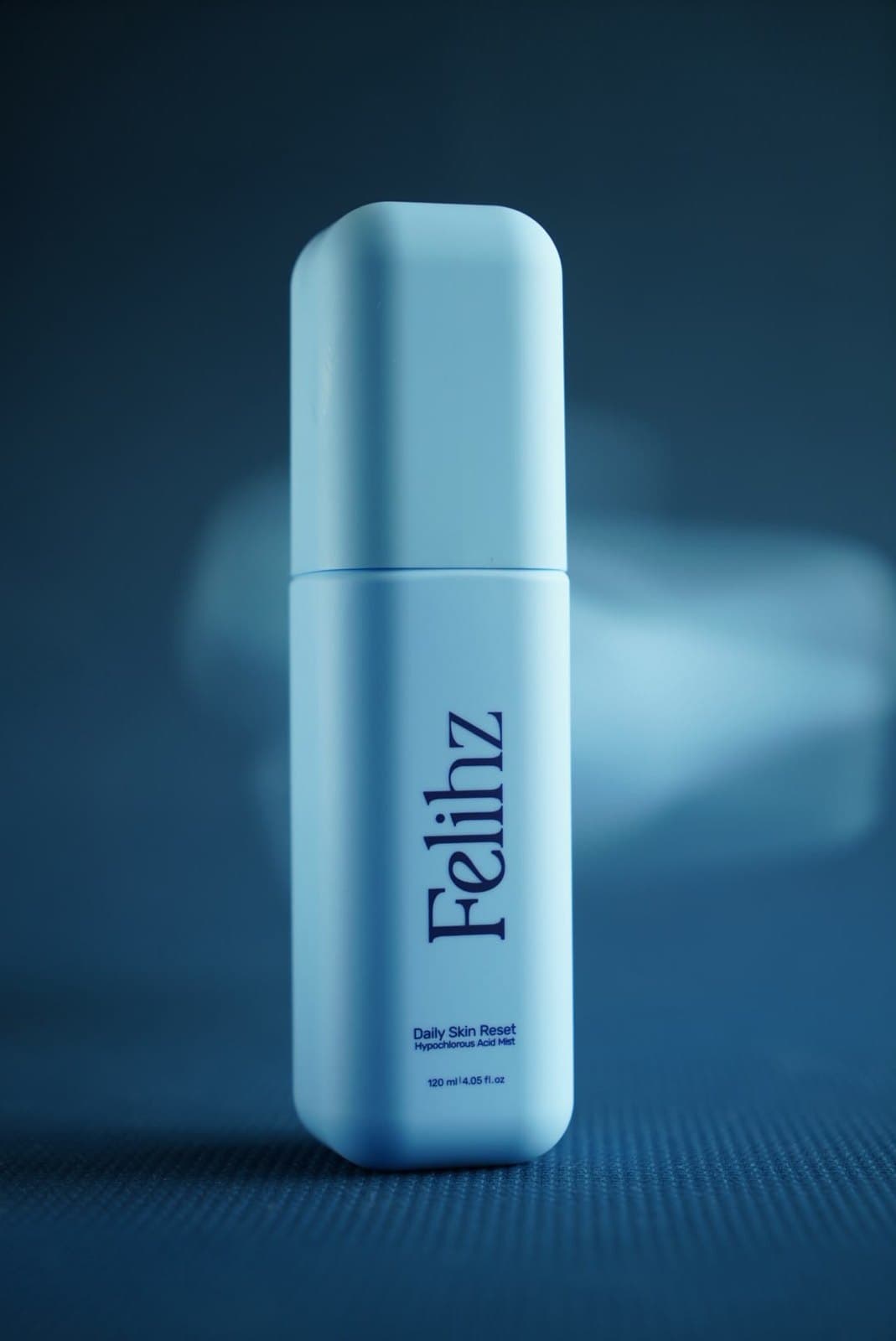
Four ingredients — water, hypochlorous acid, salt and a pH adjuster — at 200 PPM, fragrance-free, made in India, with the strength on the carton. The full account is in the face spray explained, or see the product itself: Daily Skin Reset.
Written by Felihz